Is The Ramen Talking To HQ?
My wife and I were shopping at Fred Meyer. As we walked up to checkout, I glanced over at the candy and other stuff on the display. Something about the price tags looked off. The colors didn’t look like the usual black text on white paper, and the tags had more information than I was used to seeing: quantity, price per unit, and the current sale price.
I thought they looked like e-ink screens, but I didn’t think stores actually used digital price tags. So I looked it up, and sure enough, that’s what they were.
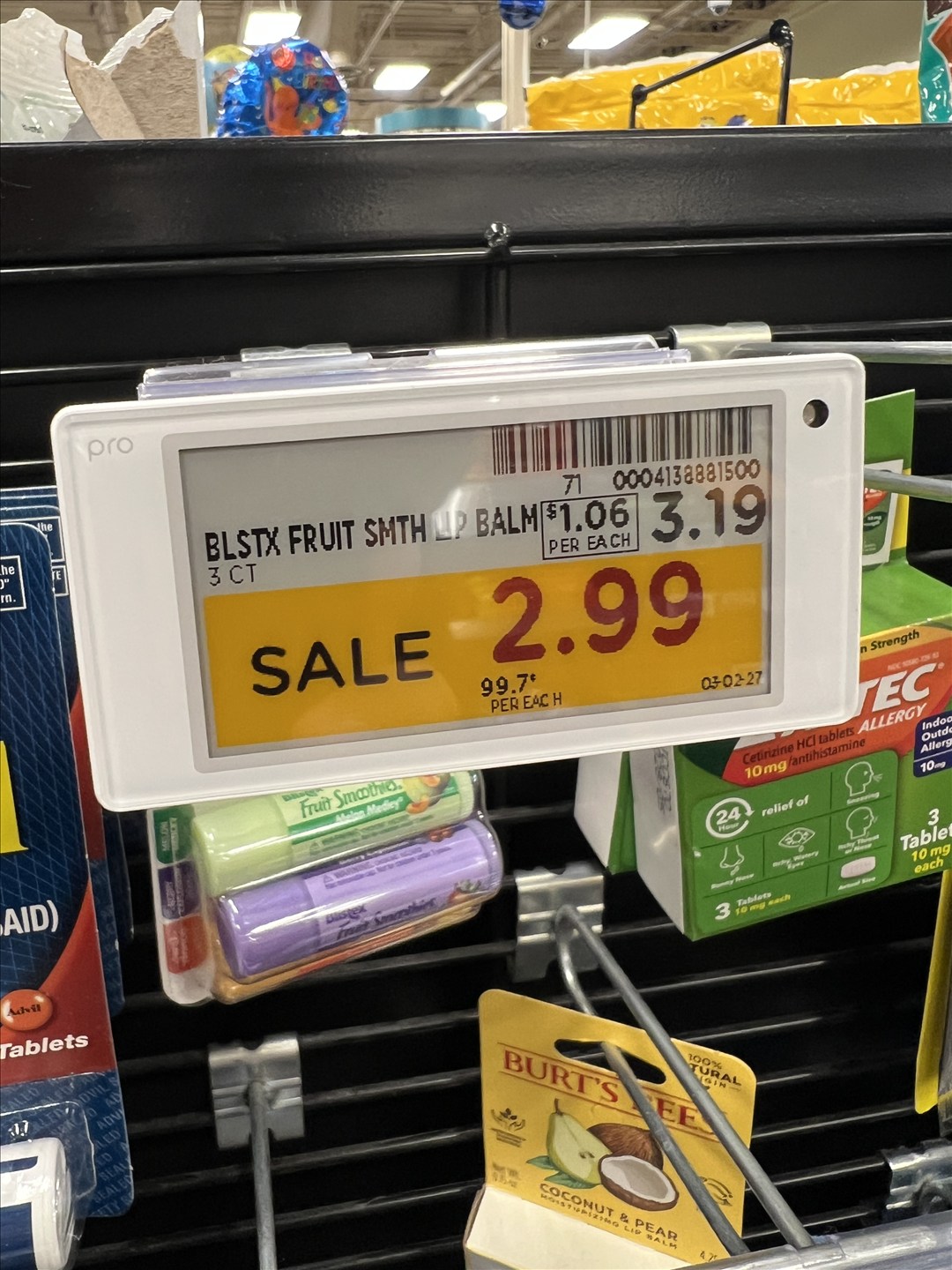
The tag I spotted near checkout at Fred Meyer. It shows the pack size, regular and sale prices, and the price per tube.
How do these things work?
Each electronic shelf label system works a little differently. For this article, I’ll focus on Vusion, whose retailer presentations include Kroger, Fred Meyer’s parent company. That doesn’t confirm which system my local store uses, but it gives us an example to explore. Vusion retailer presentation
Electronic shelf labels (ESLs) come in various sizes and formats. Some show basic pricing information, while others use color to highlight sales and promotions. Certain models also include near-field communication (NFC) or LED indicators that let shoppers access additional information or help employees locate products. Vusion’s ESL documentation
The labels communicate with access points or gateways inside the store. Depending on the hardware, Vusion uses proprietary radio protocols or Bluetooth Low Energy (BLE). The gateways connect the labels to the cloud platform and can plug into the store’s existing wired network. Supported technologies, Infrastructure options, Gateway datasheet, Cisco deployment guide
Vusion’s cloud platform supports API integrations with point-of-sale (POS), enterprise resource planning (ERP), and other retail systems. These integrations allow the retailer’s existing systems to supply pricing and product information to the labels. How much work that takes depends on the systems and workflows involved. Vusion’s cloud-platform documentation
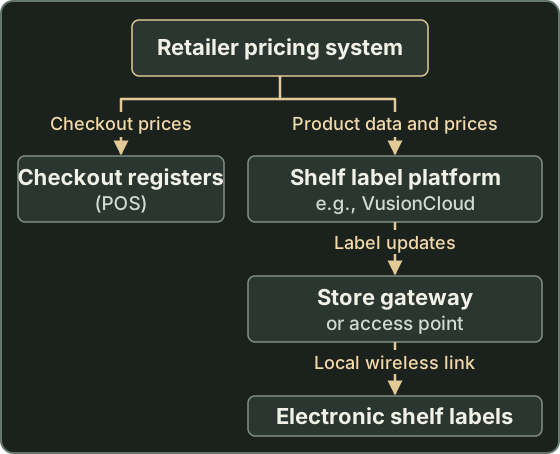
Example implementation. The retailer’s pricing system feeds checkout and the shelf label platform separately. The platform sends label updates through a store gateway to the tags.
Why do stores want them?
Stores want them mainly to save money. Three benefits stand out to me:
- Less time changing price tags. Associates spend less time printing, replacing, and checking paper labels, allowing them to focus on customers or other store upkeep tasks.
- Fewer pricing errors. Keeping shelf labels aligned with checkout prices means fewer discrepancies for employees to investigate and correct. Pricing mistakes can also damage customers’ confidence and cost future sales. Stores may offer price adjustments to resolve complaints and keep customers coming back.
- Faster price and promotion changes. Stores can schedule sales and update labels across a store without waiting for someone to replace each tag. That makes it easier to respond to changing prices and compete with online retailers. Vusion’s pricing and promotion documentation
What security questions does this raise for me?
Putting the labels for multiple stores under one cloud dashboard makes price changes easier. It also gives a compromised account a much bigger reach. Accounts and integrations are the first places I’d look. Let’s say someone gets into an admin account with access to several stores. Depending on what that account can do, they could change prices on thousands of tags from one place. Vusion’s permissions documentation
Changing a shelf tag doesn’t automatically change what the register charges. A $5 item could show up as $1 on the shelf and still ring up at $5. But if the label platform can write price changes back to the retailer’s ERP system, and that system feeds prices to the registers, the unauthorized discount could reach checkout too. That depends on how the retailer set up the integration. Vusion’s integration documentation
API keys raise a similar concern. Say the retailer’s ERP uses an API key to send price updates to the shelf labels. If the key can update prices across the entire chain, anyone who steals it could send unauthorized updates to all those stores. For the labels it can reach, that could do as much damage as a stolen admin login. Vusion’s API guidance
What do I think about them?
My first job was in retail. I mostly bagged groceries and cleaned, but I saw how much time associates spent changing prices and the awkward angles they had to get into just to reach some of the tags. I’d be glad to see them spend less time doing that. As a shopper, I also like that stores can update sale prices quickly. It’d be great to get the sale price I see on the shelf without having to open an app and clip a coupon first.
That convenience is worth having if stores secure the system properly. I’d want strong passwords and multifactor authentication for admin accounts, and I’d rotate long-lived API keys at least yearly and revoke them right away if they leak. I’d also want systems actively monitoring for unusual network traffic or a sudden price change across several stores. NIST’s password guidance, Vusion’s API guidance
I don’t think we’re about to see personalized prices on grocery shelves. It’s much easier to show two people different prices online than when they’re standing in front of the same tag. Still, I see this as a step in that direction, even if that’s not why stores are buying the tags. What seems more likely to me is that the price everyone sees changes more often. If some produce is in short supply, a store could adjust its price daily. I could also imagine a store nudging the price of a popular product up a few cents at a time to see how shoppers react.